Google Ads Quality Score is a 1–10 diagnostic rating assigned at the keyword level in Search campaigns. The Quality Score rating estimates how relevant and useful an ad is for users based on three components: expected click-through rate (CTR), ad relevance, and landing page experience. In digital advertising, Quality Score influences Ad Rank and cost per click (CPC), and it helps advertisers evaluate competitiveness within the ad auction.
A higher Quality Score can reduce CPC and improve ad placement. According to WordStream, keywords with a Quality Score of 10 can achieve up to 50% lower CPC compared with average-performing ads.
This article explains what Quality Score represents, how Quality Score differs from Ad Rank, and how to improve Quality Score using practical optimization steps.
Key Facts
- Quality Score is rated on a 1–10 scale at the keyword level.
- Quality Score is a diagnostic tool, not a performance metric.
- Quality Score is based on expected CTR, ad relevance, and landing page experience.
- The visible 1–10 Quality Score rating does not directly enter the auction.
- Higher ad quality can improve your Ad Rank and reduce CPC.
Clicks Are Expensive. Don’t Waste Them
Design landing pages that work perfectly with your digital strategy – and boost your ROI.

What is Google Ads Quality Score?
Google Ads Quality Score is a diagnostic tool that shows how ad quality compares with other advertisers targeting similar keywords. Inside your Google Ads account, Quality Score is visible at the keyword level and serves as a quick diagnostic indicator of ad quality.
Quality Score is measured on a 1–10 scale and available at the keyword level in Search campaigns. Google calculates it based on expected click-through rate, ad relevance, and landing page experience, evaluating how well your ads respond to a user’s search query.
In practice, Quality Score helps you locate problems in ads, keywords, and landing pages. It highlights weak areas in ad quality before they hurt performance.
Think of Quality Score as a keyword-level health check for your campaigns. It helps you understand how well your ads align with a user’s search and how competitive they are within the auction environment.
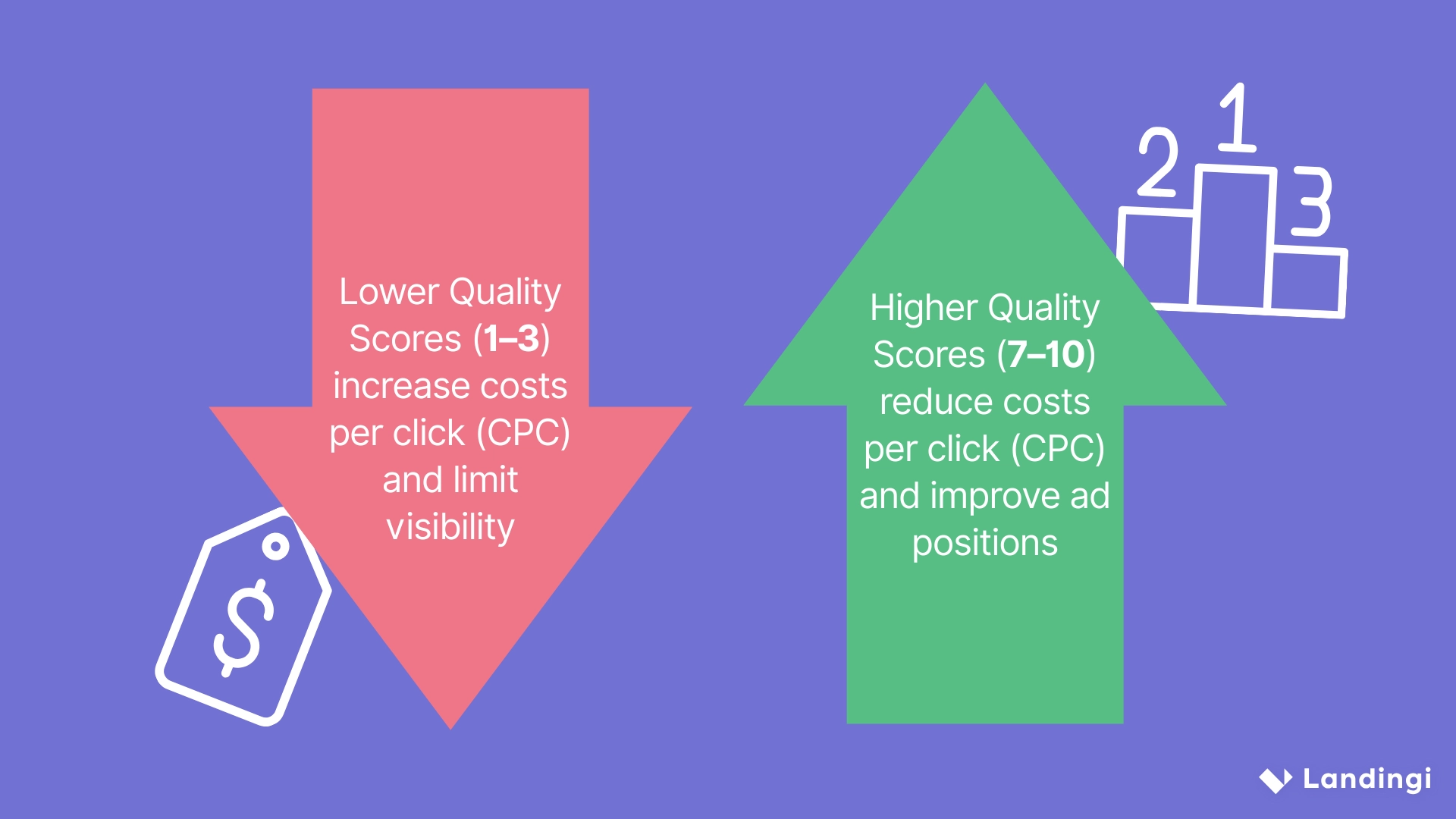
Higher Quality Scores (7–10) reduce costs per click (CPC) and improve ad positions. Lower Quality Scores (1–3) increase costs per click (CPC) and limit visibility.
Google states that higher quality ads can lead to better ad positions and lower costs, even with similar bids.
How to interpret Quality Score signals
When analyzing campaign performance, use Quality Score components as diagnostic guidance:
- If CPC is high and impressions are low, review Ad Rank and keyword eligibility before adjusting Quality Score factors.
- If impressions are stable but CTR is weak, prioritize improvements in expected CTR and ad copy relevance.
- If CTR is strong but conversions are low, evaluate landing page experience and intent alignment.
Quality Score is most reliable in Search campaigns with stable traffic and clear keyword intent segmentation. For new or low-volume keywords, Quality Score ratings may fluctuate due to limited data. In early-stage campaigns, prioritize campaign structure, keyword grouping, and message consistency before focusing on score optimization.
Turn better ads into better results. Build landing pages that lift your Quality Score!
Is Quality Score a KPI?
Quality Score is not a KPI. Google defines Quality Score as a diagnostic tool and advises advertisers not to aggregate the 1–10 rating with core performance metrics.
It does not represent real-time auction performance. It also does not measure profitability.
Instead of focusing on Quality Score as a goal, track business metrics. Monitor CPA to control acquisition cost. Track ROAS to measure return on ad spend. Watch conversion rate to see how traffic performs. Check impression share to understand visibility.
Quality Score supports performance analysis, but it should not replace business KPIs. Well-structured ad campaigns that deliver strong engagement and conversions often generate higher Quality Scores as a byproduct of performance improvements.
Treat Quality Score as a diagnostic layer: identify weak components, implement changes, and validate results using CPA, ROAS, and conversion rate data.
Quality Score vs Ad Rank
Quality Score is a visible 1–10 diagnostic score, while Ad Rank determines your actual ad position in the auction.
Ad Rank decides whether your ad shows and where it appears. It is calculated using bid amount, auction-time ad quality signals, and other factors. Ads with low Quality Scores (typically 1–3) may not be eligible to show, regardless of bid amount.
Although the 1–10 score is not directly used in auctions, the same core quality signals influence both Quality Score and Ad Rank. While advertisers may see the same Quality Score, their Ad Rank can still differ depending on bids and auction-time signals. Expected CTR, ad relevance, and landing page experience shape ad quality. Improving these factors can raise Ad Rank, improve ad placements, and lower CPC.