Google Ads and Microsoft Advertising (formerly Bing Ads) dominate search advertising, with Google holding approximately 82% of global search ad revenue share and Microsoft at 12% as of 2025 benchmarks. Choosing the right platform for your digital advertising strategy can boost ROI by up to 3x depending on your niche.
In this article, we compare Google Ads vs. Bing Ads based on market share, audience, features, and performance across industries. We’ll also break down advertising costs using current CPC data to help you decide which platform suits your business goals and budget.
Clicks Are Expensive. Don’t Waste Them
Design landing pages that work perfectly with your digital strategy – and boost your ROI.
Improve ad performance

What is Google Ads?
Google Ads is an online advertising platform developed by Google that allows businesses to display ads across its search engine and partner sites. Google defines the platform as a program enabling advertisers to create online ads to reach people exactly when they’re interested in the products and services that you offer.
The platform supports both search and display advertising with extensive reach. Ad placements appear in Google search results, on YouTube, in Gmail, and across over 2 million websites in the Google Display Network. This broad distribution allows businesses to connect with potential customers at multiple touchpoints throughout their online journey.
Google Advertising operates on a pay-per-click (PPC) model, where advertisers bid on keywords and pay only when users click their ads. Through Google Search, advertisers reach users actively searching for specific terms – capturing high-intent traffic at the moment of interest. Meanwhile, the Google Display Network enables broader audience reach through visual banners and video formats, ideal for building awareness and retargeting.
Google Ads typically serves a variety of goals – ranging from increasing website traffic and generating leads to promoting brand awareness and driving online sales. The platform includes tools for performance tracking, A/B testing, and campaign optimization, making it suitable for both small businesses and large enterprises.
Build Your Page
Your ads drive traffic – Landingi turns it into leads and sales. Start building today!
What is Bing Ads?
Microsoft Advertising, formerly Bing Ads, is a digital advertising platform that enables businesses to display paid ads within the Bing search engine and across partner sites. Microsoft defines it as a pay-per-click (PPC) advertising platform used to display ads based on the keywords used in a user’s search query.
The platform allows advertisers to reach users through multiple channels. Microsoft ads appear in search engine results and across the display network, including MSN, Outlook.com, and other Microsoft-owned properties. Businesses can create various ad formats – text ads, shopping ads, or responsive ads – and target audiences by location, demographics, or device type.
Bing’s market share in global search engines was approximately 4.03% as of Q4 2025, according to StatCounter. While smaller than Google’s, it reaches a distinct audience segment, especially in the U.S., where its desktop market share exceeds 6%.
Microsoft Advertising enhances campaign management with advanced reporting, keyword planning tools, and unique integration with LinkedIn profile data for refined targeting.
Boost Conversion
Different platforms, same goal: conversions. Create ad-ready landing pages with Landingi.
6 Key Differences Between Google Ads and Bing Ads
While Google Ads and Microsoft Advertising (formerly Bing Ads) operate on similar pay-per-click models, they differ significantly in reach, audience composition, cost structure, and platform capabilities. Understanding these distinctions helps you make informed decisions about where to allocate your advertising budgets.
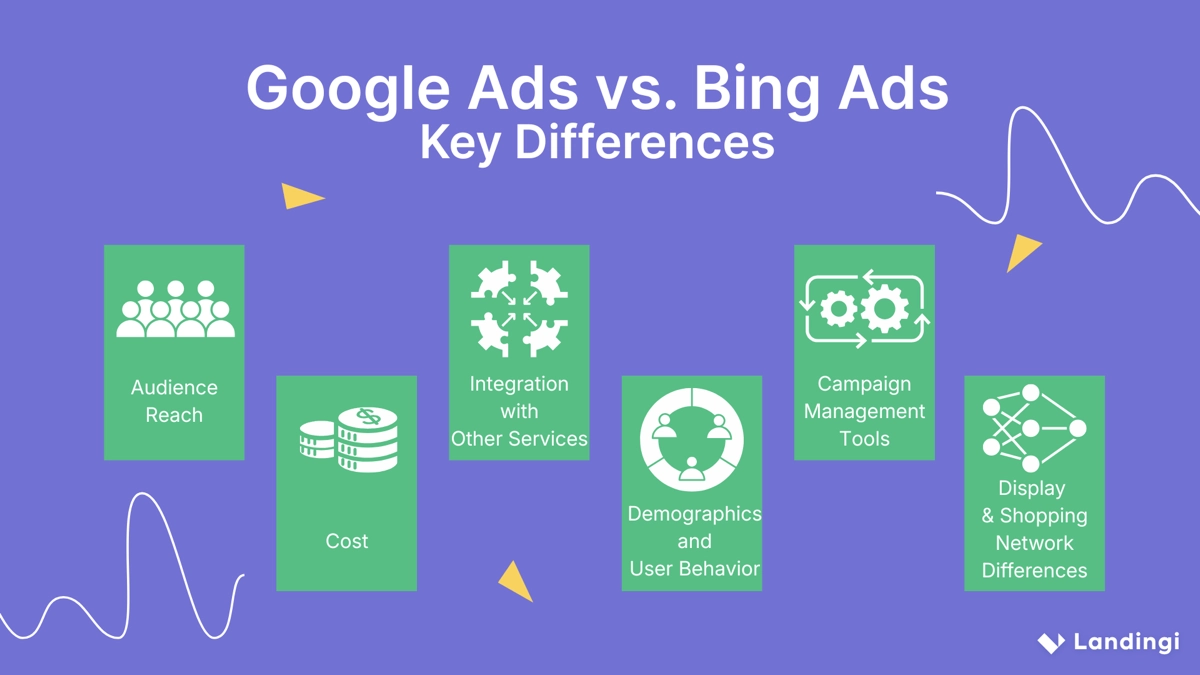
1. Audience Reach and Market Share
Google Ads dominates the search advertising market. As of Q4 2025, Google controls 90.83% of the global search engine market according to StatCounter, while Bing holds approximately 4.03%. This substantial difference means ads on Google typically generate significantly higher impressions and clicks due to the platform’s broader user base and search volume.
2. Cost
The cost advantage often favors Microsoft Advertising. According to PPLE Labs, advertisers on the platform pay approximately 20-30% less per click, on average, than in Google Ads. For businesses with limited budgets or those seeking to maximize ROI through lower acquisition costs, this difference can be substantial and may justify testing Bing despite its smaller reach.
3. Demographics and User Behavior
Bing’s audience profile differs notably from Google’s in ways that benefit certain advertisers. According to Microsoft’s internal data, 73% of Bing users are under 45, and 41% of US users earn over $100,000 annually. The platform’s audience also skews toward desktop use, making it particularly effective for targeting more affluent, professional users in industries such as finance, B2B services, and luxury goods.
Build Personalized Pages
Set up ads. Drive traffic. Convert smarter. Start using Landingi today.
4. Integration with Other Services
Platform ecosystems create distinct targeting opportunities. Google Ads integrates seamlessly with Google Analytics, YouTube, and Google My Business, enabling comprehensive cross-platform campaign tracking and optimization. Microsoft Advertising, however, offers a unique advantage through its LinkedIn integration, enabling advertisers to target users based on professional attributes such as job title, company, and industry.
5. Campaign Management Tools
Both platforms provide robust campaign management capabilities, though Google Ads leads in automation sophistication. Google’s platform offers more advanced machine learning features, predictive analytics, and automated optimization suggestions. Microsoft Advertising supports similar core functionality but typically implements new tools and features more slowly, with fewer AI-driven optimization recommendations.
6. Display and Shopping Network Differences
Network reach varies considerably between platforms. Google’s Display Network spans over 2 million websites, apps, and video platforms, providing unmatched scale for display campaigns. Microsoft’s display network, while smaller, reaches users through high-quality properties including MSN, Outlook, and other platforms. For Shopping Ads, Google maintains wider adoption and traffic volume, though Microsoft supports product listing ads with comparable functionality that may deliver better ROI due to lower competition.
Google Ads vs. Bing Ads – Cost Comparison
Google Ads is typically 2× to over 5× more expensive than Microsoft Advertising, especially in competitive industries. This is confirmed by WordStream’s benchmark data, which shows that Google’s average CPCs are consistently higher across industries:
| Industry | CPC – Google Ads | CPC – Microsoft Advertising |
|---|---|---|
| Legal Services | $8.58 | $1.42 |
| Home Improvement | $7.85 | $1.50 |
| Education | $6.23 | $1.22 |
| Finance & Insurance | $3.46 | $1.82 |
| Health & Fitness | $5.00 | $1.24 |
| Travel | $2.12 | $1.17 |
While Google offers a larger reach, PPC advertising on Bing costs significantly less per click. For brands in cost-sensitive sectors, Microsoft Advertising can provide more efficient results across both ad platforms.